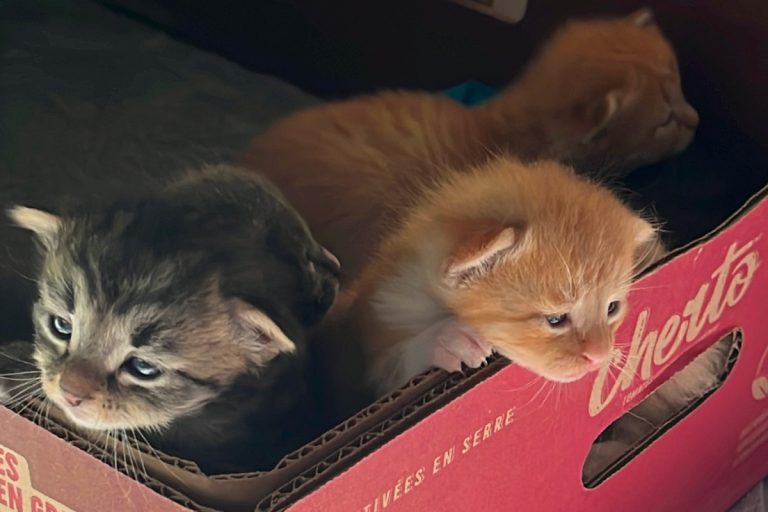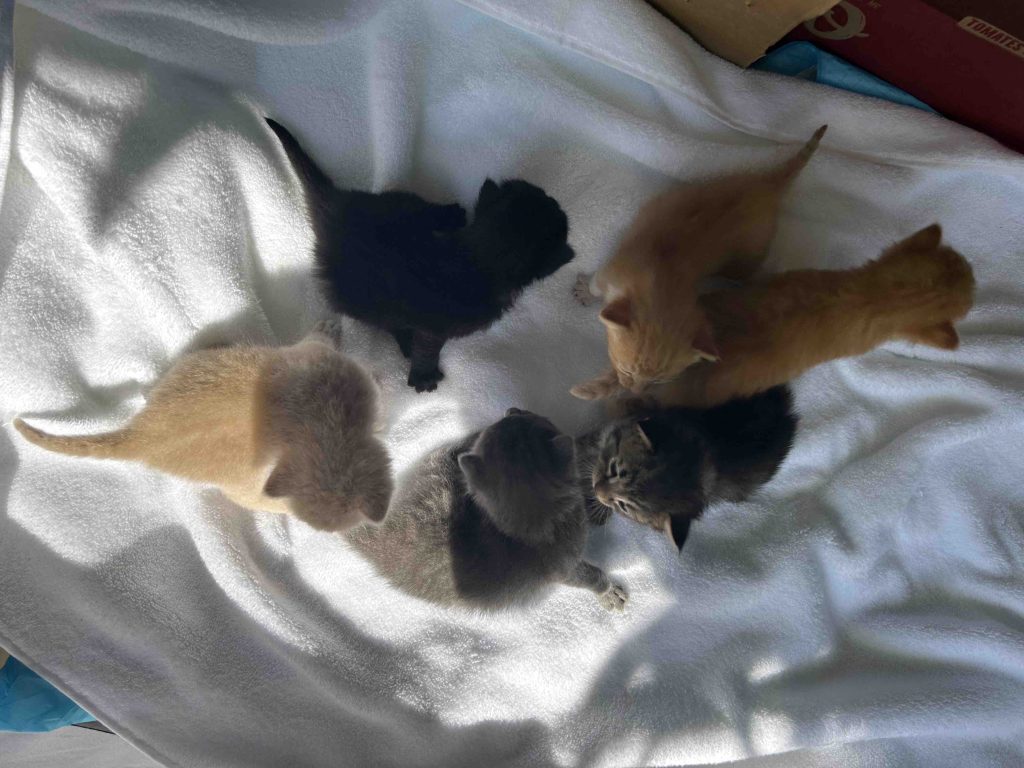
Nobody told me I was socializing kittens nor how socialization actually works. I was just changing a wetting pad.
Every morning, I’d slip into the nesting area while Conan was eating — that was the window. She trusted me enough by then to step away from the box without panicking, which hadn’t always been the case. In the early days she watched every move. By week two, she’d eat and let me work. That was its own small miracle.
The routine was simple: swap the pad, check on everyone, say good morning. I’d lean over the box and say helllloooooo in that slightly unhinged high-pitched voice that you develop when you spend enough time around small animals. And every single morning, six tiny heads would pop up.
That’s when I realized something was happening.
They knew my voice before they could do much else.
Kittens are born with their eyes sealed shut. For the first week or so, their world is almost entirely sound, warmth, and scent. They can’t see you. They don’t know what you look like. But they hear you — and if you’re consistent, they start to associate that sound with safety.
I wasn’t doing anything strategic. I was just showing up every day and talking. To them, to Conan, sometimes to myself while gardening nearby. If they were awake, they’d hear me through the walls of the box and start mewing back. I’d say hellooo and they’d answer. My neighbors probably thought I was totally nuts.
But that back-and-forth — that call and response — was the whole thing. That was socialization.
What it actually is & How socialization actually works
Socialization in kittens isn’t a training program. It’s not something you schedule. It’s the slow accumulation of experiences during a critical developmental window — roughly weeks two through seven — where kittens learn what is safe and what isn’t.
A human voice, heard daily, becomes safe. Hands that touch gently and consistently become safe. The smell of a familiar person becomes safe. None of this happens in a single interaction. It happens because you keep showing up.
What I was doing every morning — changing the pad, saying good morning, handling them briefly and calmly — was building a record. Every positive interaction added to it. By the time their eyes were fully open and they were tumbling around the box, I wasn’t a stranger to them. I was part of the pattern of their days.
What it looked like in practice
Duke was the first to respond physically. Bold, loud, always front and center — if I leaned over the box, he was already pushing toward me. Sora was right behind him, vocal and opinionated about everything. Clyde would be mid-escape attempt and somehow still find time to acknowledge me.
Houdini took longer. He was the gentlest of the six, a little more cautious, more likely to hang back and watch before committing. But once he decided I was fine, he was the most relaxed in human hands of all of them. He’d just go still and let you hold him, totally calm. That kind of trust doesn’t come from one interaction. It comes from twenty.
Ringo and Shaolin were steady. Present, engaged, not as loud about it as Duke or Sora. They’d let you handle them, respond to your voice, go back to whatever they were doing. Reliable in the best way.
The moment I knew it had worked
There wasn’t a single dramatic moment. It was more like a slow accumulation of small ones.
The morning they started mewing before I even opened the box — just from hearing my footsteps. The first time Houdini fell asleep in my hands. The day Sora climbed my arm like it was a route she’d been planning for weeks. The way all six of them would go from scattered chaos to alert attention the second I said heelllooo.
They made it clear, without any ambiguity, that I was one of them.
I didn’t plan any of this. I didn’t read a socialization guide before I started. I just showed up every morning, kept my voice calm and consistent, handled them gently, and let time do the rest. That’s what socialization actually is — not a technique, but a commitment to showing up the same way, day after day, until the animal in front of you decides you’re safe.
Six kittens made that decision. I like to think they made the right call.
If You’re in This Situation Right Now
You don’t need a plan. You need a routine.
If you’ve found yourself accidentally caring for a mama cat and her kittens, the most important thing you can do is be consistent. Same time, same voice, same calm energy. You don’t need to handle them for long—even a few minutes a day during that two-to-seven week window is enough to make a difference.
Talk to them. It sounds ridiculous but it works. Let them hear you before they see you. Move slowly. If a kitten tenses up, put it down. Let it come back on its own terms.
You’re not training them. You’re just giving them enough good experiences that the world—and the humans in it—starts to feel like something they don’t need to be afraid of. That foundation follows them into every home they’ll ever live in.
It’s the most low-effort, high-impact thing you can do for an animal that had no say in where it was born.